
How Do Professionals Taste Olive Oil?

Once upon a time, “Extra Virgin” or “First Cold Pressing” was all anybody thought they needed to know, or all anybody could know, in order to choose a high-quality olive oil from a grocery or specialty store shelf. In contemporary practice, those terms have lost some weight, at least without added context or certification. First, cold pressing no longer accurately describes how an oil is expressed, and the term extra virgin says nothing about how the olives were treated or stored, nor for how long, before being made into olive oil.
Sensory Evaluation of Olive Oil

Olive oil tasting
While “Extra Virgin” should still be a requirement for most consumers seeking high-quality olive oil, not everything labeled “extra virgin” is automatically of equal quality. Brands may label their oil as extra virgin so long as it meets certain production requirements and passes a chemical analysis. By USDA standards, oils labeled as extra virgin must have a maximum free fatty acid content of 0.8 grams per 100 grams, or 0.8 percent by volume.
In the late 1980s, the International Olive Oil Council (IOC) introduced a sensory evaluation component in addition to the chemical analysis, which was put into practice by many countries or professional consortiums in the early 1990s, such as the California Olive Oil Council, (COOC) and the North American Olive Oil Association. (The USDA Extra Virgin requirement also includes a sensory evaluation, but olive oils in the U.S. can still be labeled Extra Virgin without the USDA designation in order to avoid the additional scrutiny.)

Nancy Ash
This practice gave rise to olive oil sommeliers, or those who were specifically trained to participate in these sensory evaluations, and the additional assessment is what helped to elevate the extra virgin olive oil category, separating what’s high quality extra virgin olive oil from what’s merely passing muster. “Big producers have always fought against sensory analysis,” says Nancy Ash, President of Strictly Olive Oil. “It works against them because they want to put marginal olive oil in bottles and sell it at cheap prices, but they want to call it extra virgin because that's what consumers are looking for.” Knowing how olive oil is professionally evaluated can help you become a better buyer and consumer.
As one of the original panelists in professional olive oil sensory evaluations, Ash is an expert on various aspects of olive oil evaluation for certification purposes. While Ash previously contributed her insight about How to Host an Extra Virgin Olive Oil tasting at Home, here is even more to know about how professional olive oil tastings work.
Sensory Evaluation Takes Place in Panels
Sensory evaluations are designed to be as scientific as possible, while still relying on the subjective nature of human perception. To that end, no single person determines whether an oil meets the extra virgin olive oil standard. According to the IOC standards, panels must have at least eight people, who meet together such that they are tasting the same oil from the same bottle in the same condition.
“It's never one person's opinion, which is subjective,” says Ash. “It's always the group's consensus that makes it a valid tasting, or not, for scientific purposes.” A spreadsheet from the IOC, pre-populated with different characteristics and formulas allows the tasting panel leader to plug in scores to determine the outcome of the tasting.
The Mechanics of Olive Oil Tasting Are Similar to That of Wine
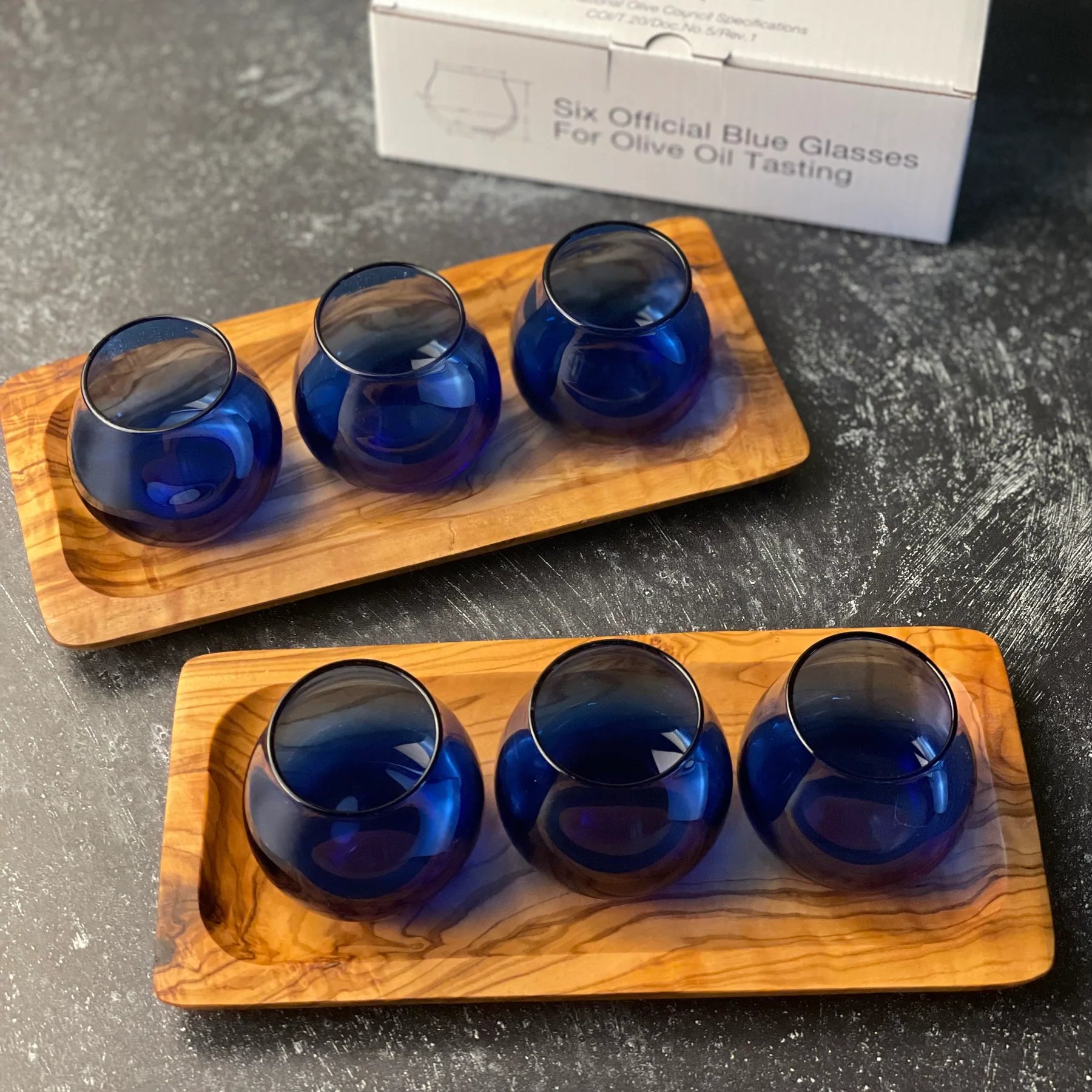
Olive oil tasting glasses photo courtesy of American Olive Farmer
If you’ve ever participated in a wine tasting, many of the mechanics are very similar (with a couple of notable exceptions, below.) Tastings follow the four-S system, which doesn’t get to the point of actually putting oil to lips until S number three.
“First we swirl, and that releases the esters, which are the aroma molecules,” says Ash. “The second move is to sniff, doing a quick inhale from the top of the glass.”
The next S is to slurp, but only a micro amount. “People think we’re taking shots of olive oil, but that’s not what we’re doing,” Ash explains. The amount in the tasting glasses is minor to begin with, so the sip is very small. “I tried to measure it one day,” she says. “That was a funny experiment, and it amounted to about a quarter teaspoon.” Like wine tasting, the slurp also involves taking a little air with the oil, and letting the oil spread across your palate.
Finally, “then you do swallow it,” says Ash, (unlike some wine tasting) “because you get that pungency in your throat.”
Extra Virgin Olive Oil is Judged Blind
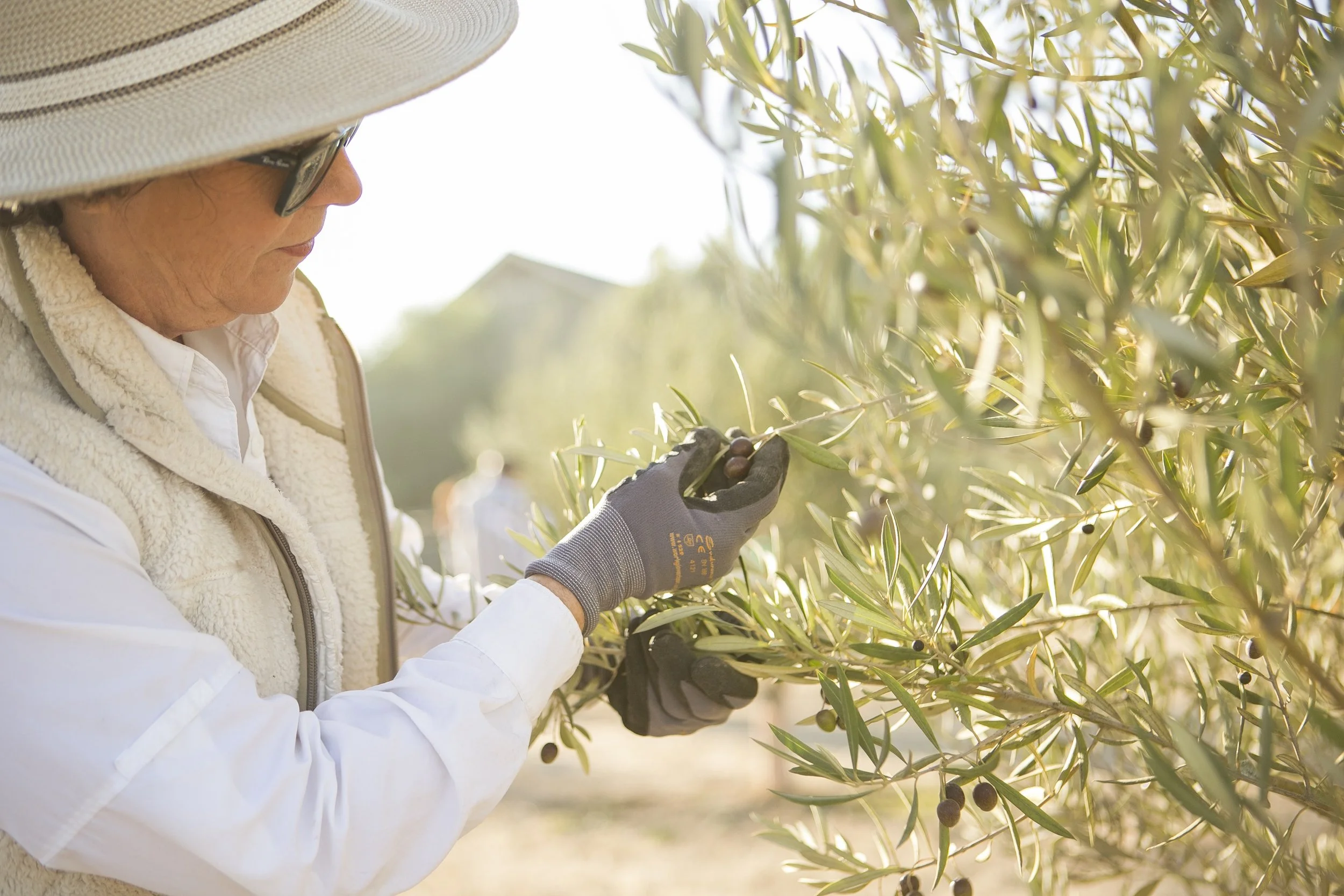
Birch Creek Harvest care of COOC
The main difference between olive oil tasting and wine tasting has to do with another S: the one that typically stands for “see” or “sight.” Whereas in wine, color can tell you certain things about the variety or the age, in olive oil, sight counts for nothing. “Color doesn't make a difference,” says Ash. “We assess the oils in these blue or red tasting glasses that block out the color. I could put water in the glass, and it would look exactly the same to me.”
The reason behind this is that much like how Cheddar came to be yellow, it’s possible to adulterate the color of olive oil so that it appears greener. “In the 1980s we were taught to look for green oil,” Ash explains. “So, then producers developed these ways to make the oil look green, but it actually distracted from the oil’s quality.” Now, the color of olive oil has no bearing at all on the outcome of the tasting since it has no bearing on the quality.
Positive Attributes are Sensations More Than Flavors
The three positive attributes that professional tasters are looking for in extra virgin olive oil are fruitiness, bitterness, and pungency. While specific tasting notes may get ascribed to different olive oils at the labeling or marketing stage, which could reasonably fall under any of those three attributes, in the evaluation of EVOO, these positive attributes are sensations, not flavors.
“What we're looking for in that first inhale is the reflection of positive olive aroma,” says Ash, “and that's what's called fruitiness, but which is a bad translation of what it was first called in Spanish.” Olives are indeed, biologically speaking, a fruit, which isn’t the issue, but at this stage professional panelists aren’t so much trying to unpack the oil in terms of its potential tasting notes, but just looking for that which is simply an appropriate essence of olive.
As for bitterness, “those receptors are all over your tongue,” says Ash, hence the slurp aspect of the tasting to spread the oil out across the palate so that pros can perceive the full extent of the oil’s bitterness. “They're not just in one spot, but the larger ones are towards the back of the tongue.”
As for pungency, it has been described as a slight, peppery, choking sensation, or that which causes you to cough. “I do this class for consumers at a store in Los Angeles once or twice a year, and usually during the first one everyone coughs and says, ‘oh, that's really pungent,’” recalls Ash. “And I say, ‘no, it's not.’ But if you've never thought about that sensation before, it can be unexpected.” One cough is good. Two coughs (or more) is better.
Negative Attributes Are Highly Specific
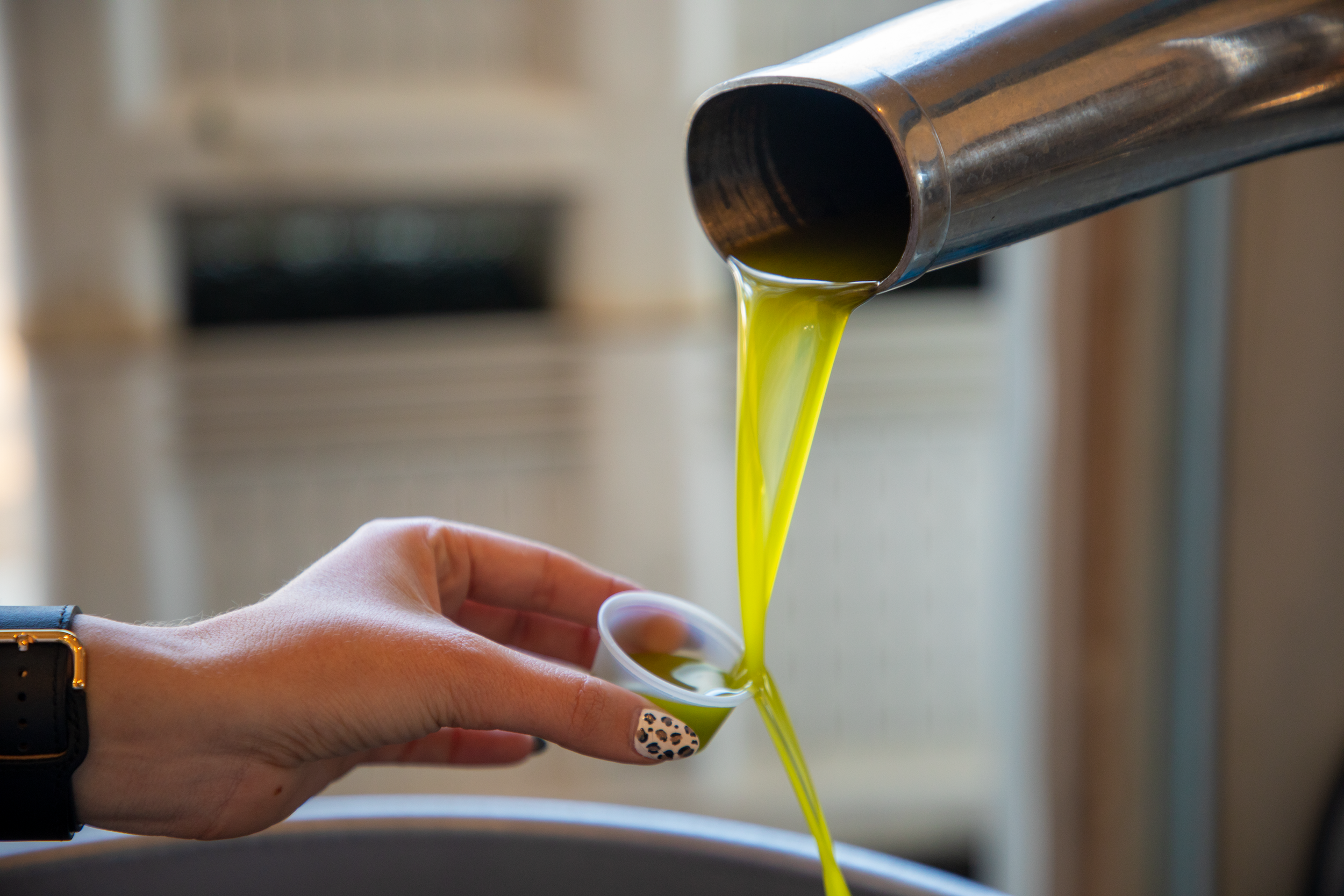
Pasolivo Tasting Room care of COOC
In evaluating extra virgin olive oil for its negative attributes, however, there’s much more to it than just the sensation of “this seems off.” Whereas positive attributes are based on sensations, negative attributes represent different, highly specific aromas. “I love these,” says Ash. “It's like the seven dwarves. There's fusty, musty, winey, rancid, muddy, briney, grubby…” and several others. These flaws can arise due to growing or climatic conditions, production issues, and mishandling during transportation and storage.
Rancidity is typically the most common flaw in extra virgin olive oil, which reflects oxidation. “The reason that it's the most common one is that all olive oils eventually become rancid,” Ash explains. “The good producers protect the oil as much as possible from oxidation, but you can't protect it completely,” she says. “So it will eventually oxidize, depending on how it's handled, bottled, stored, etc. It’s the most common and it's the easiest, I think, to identify.”
“Fustiness is the anaerobic fermentation of the olive,” Ash says, referring to the tendency for olives to begin degrading from within as soon as they are picked. Fustiness often occurs when the length of time between picking and milling is too long. “When that degradation gets to a certain level, it creates a specific flavor, and we call that flavor ‘fusty,’” she says.
The other negative attributes are less common, but are no less precise, and represent very specific issues that occurred in the oil’s life cycle.
A Single Negative Attribute Disqualifies an Oil as Extra Virgin
COOC seal
The certification of extra virgin olive oil based on the sensory evaluation isn’t merely the tabulation of points from the positive attributes minus the score from the negative attributes, where a particular number represents the threshold between virgin and extra virgin. Negative attributes don’t exist in degrees. An oil is either fusty, or it isn’t, for example.
According to Ash, “if there is consensus [among the panel] that there is a negative attribute present in the oil, then that oil would no longer qualify as extra virgin.” This is important because even if the label says "extra virgin," it might no longer be, if it is too old or wasn't properly stored.