
How Olive Oil Changes Through the Harvest Season

First bin of olives into the crusher photo credit Michele Becci
Every olive oil season begins with a single moment: the first olives passing through the mill. At Frantoio Giaramida in Sicily’s Valle del Belice, I watched that moment unfold as the season’s first load of just-picked olives emerged from the crusher as a vivid yellow-green stream of oil. This first press isn’t just a ritual; it is the starting point in the oil’s long arc for the year.
That arc begins with the first vivid, peppery drops and evolves to the softer, rounder profiles that emerge later in the season. By understanding how time, ripeness, and the progression of the harvest shape flavor, cooks can choose and use olive oil with the same intentionality as Italians do. They can match each oil to the moment in its life when it tastes best.
The First Taste: What Olio Nuovo Reveals
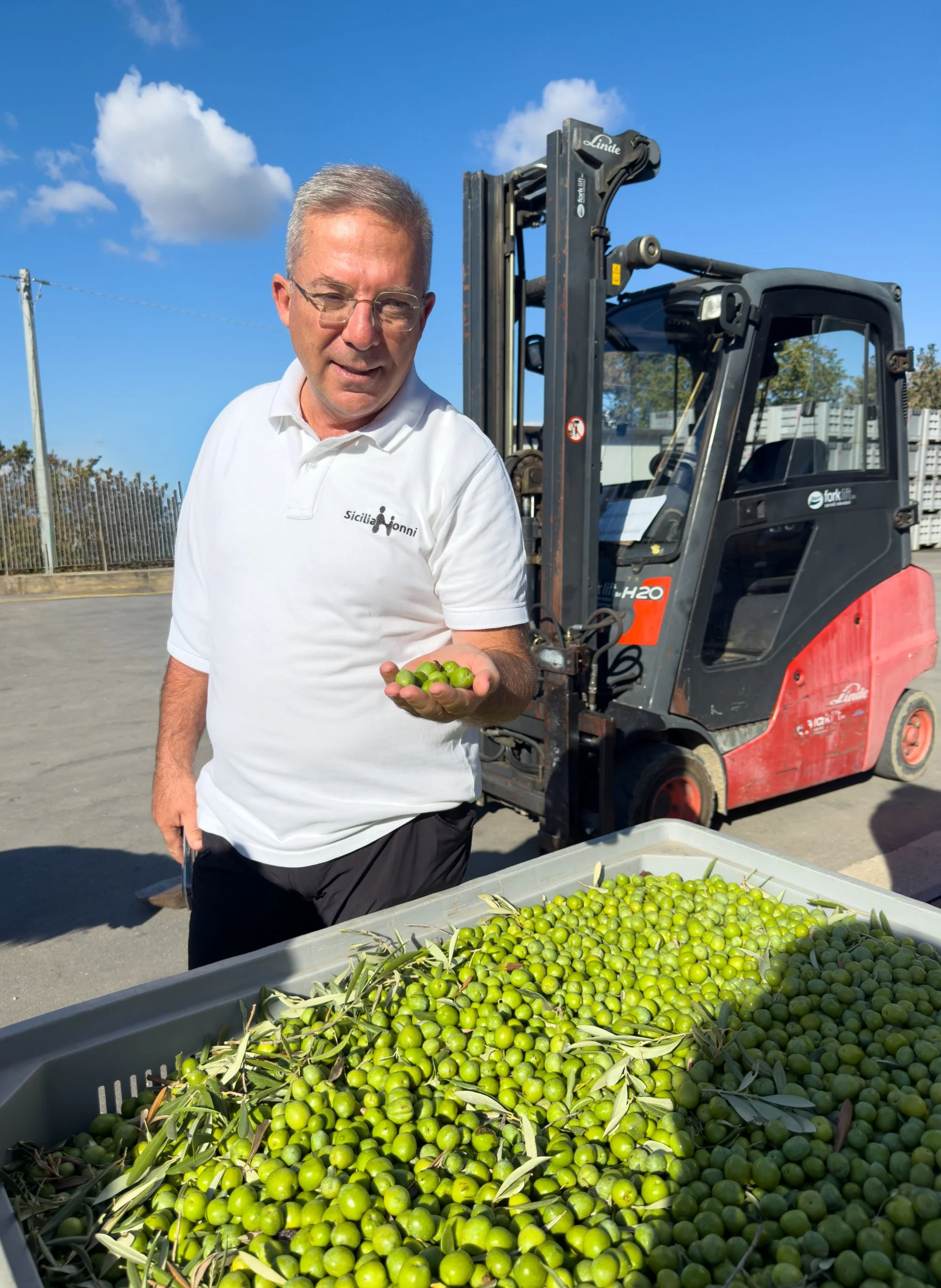
Vito Giaramida overseeing the olive harvest photo credit Michele Becci
Mill owner Vito Giaramida greets our group with easy smiles as he describes his operation, the cultivars they grow, and what olio nuovo means to producers. “The first oil tells us everything about the season ahead,” he explains.
The young, firm, green olives produce a fiercely peppery, vivid oil. They have an unmistakable back-throat bite. “If it doesn’t make you cough,” Vito jokes, “it’s not real olio nuovo.” Vito explains how rapidly the olive's chemistry changes. The earliest harvest in late September and early October yield sharp, vivid flavors. When olives are still green and firm, they’re dense with chlorophyll and phenols, which explains why the oils pressed now are so grassy and bitter.
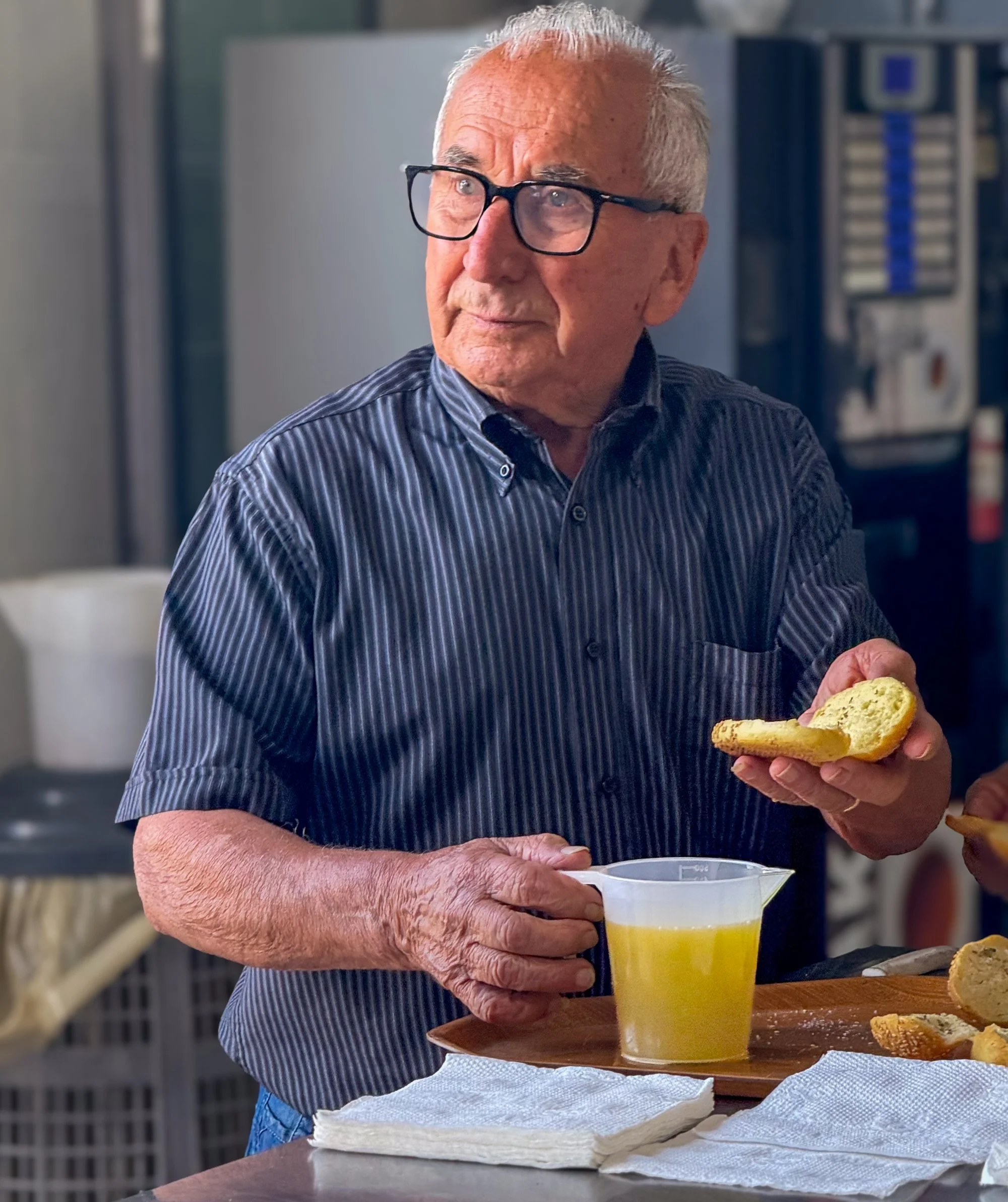
Gaspare Giaramida with his new oil photo credit Michele Becci
His mill, Frantoio Giaramida, has deep roots in western Sicily. Vito’s parents, Santina and Gaspare, learned the craft from Santina’s father, Vincenzo, who ran the mill before them. Today, the family continues to mill olives for the region’s farmers. The mill sits in the Valle del Belice, a region known for its ideal olive-growing conditions: hills that shield groves from harsh winds and the Belice River, which helps maintain soil moisture. The valley is home to three primary cultivars: nocellara del Belice, cerasuola, and biancolilla, varieties that have shaped the region’s olive-growing traditions for generations. These cultivars form the backbone of the area’s harvest each year.

Vito Giaramida and his parents, Gaspare and Santina photo credit Michele Becci
As the first press gets underway, Vito’s parents join the group. They speak only Sicilian, but their pride needs no translation. When the tractor lifts the first bin of olives off the ground, everyone instinctively steps closer, watching as the fruit tumbles into the hopper. Even local reporters are on hand to livestream the event. We gather around the stainless-steel spout as the first olives make their way through the milling line and finally appear as a vivid stream of yellow-green oil. The scent of crushed olives fills the air.
Gaspare soon calls us over to a stainless-steel table. In front of him stands a few bottles of their just-milled olio nuovo. He beams as he tells us that this is his family’s personal oil for the season. He tears open small Sicilian bread rolls, drizzles them with the fresh oil, adds a sprinkle of local dried oregano, and hands them around. Together, we taste this first oil of the season. The first bite was grassy. It is packed with a sharp, peppery kick that makes a few of us cough. It is just as Vito said it would be.
The Arc of the Season
Olio Nuovo, green olives
Mid season, olives turning color
Late season, fully mature black or violet olives
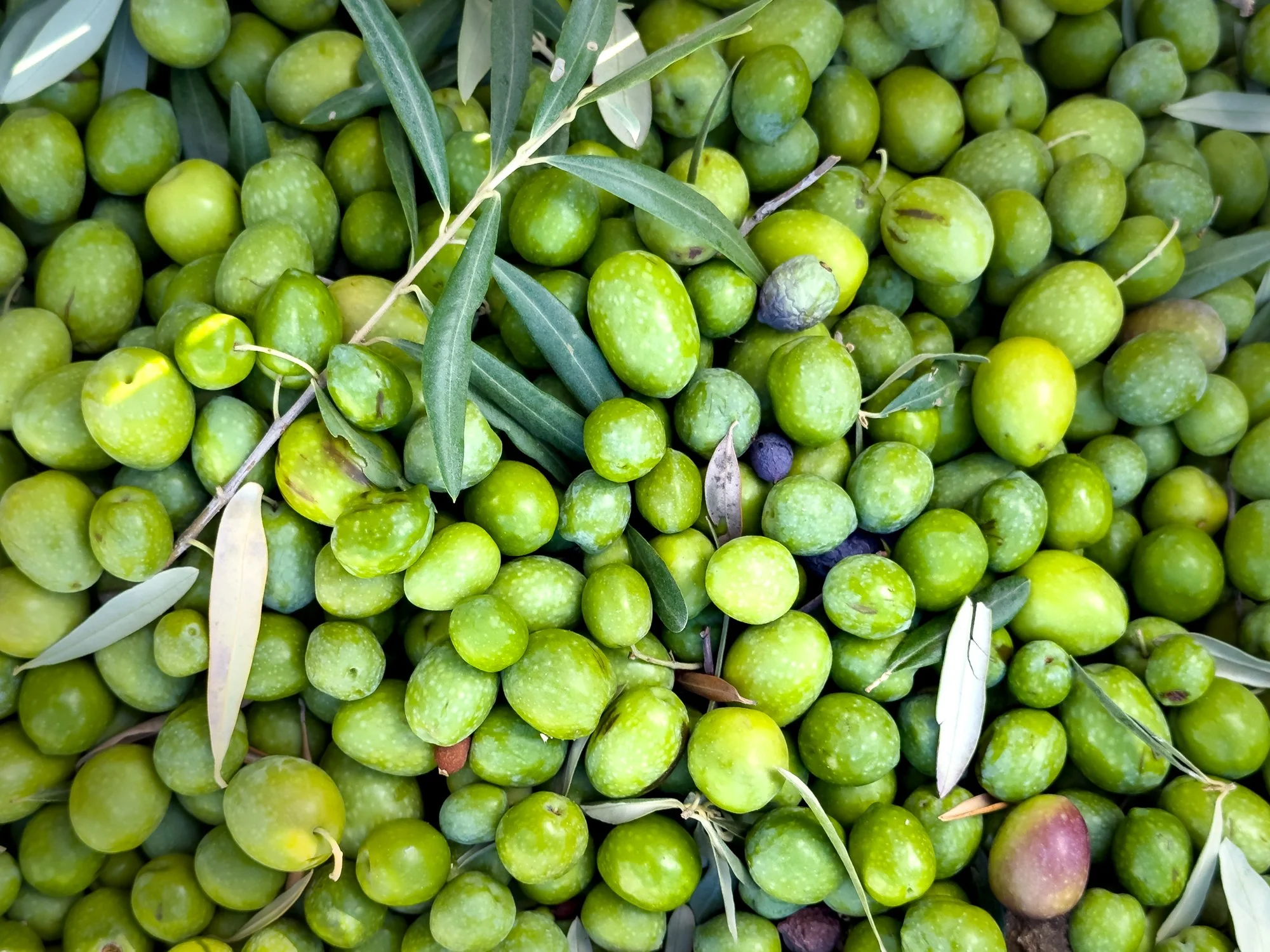
Green olives photo credit Michele Becci
While that first vivid oil captures the energy of the harvest’s beginning, the character of the fruit and the oil changes quickly as the season moves on. As the harvest progresses into November, bitterness softens, pepperiness tapers, and flavors become rounder and more approachable. These qualities make the mid-season oils friendlier to consumers.
As the olives mature and begin to turn color (a process known as invaiatura) their chemistry shifts. Moisture levels drop, and polyphenols that contribute to the bitterness and pungency decline. “This is when the oil starts to breathe a little,” Vito told us. “The fruit relaxes, the aromas open.”
The resulting oil is rounder, aromatic and more balanced. For many producers, this mid-season window offers more consistency and a more predictable yield. Oils pressed now are fruitier and slightly softer, striking a balance between intensity and aroma. For mills like Giaramida, which focus on top-quality olive oil, this is the heart of the harvest.
By the time olives reach full maturity, they turn a deep violet or black. Polyphenols drop sharply, chlorophyll breaks down, and the oil's quality declines. High-end producers rarely press fruit this mature, not because it cannot produce oil, but because it no longer meets the standards that define their work. At Giaramida and similar mills, the window for top-quality oil closes well before full ripeness.
Still, local farmers continue bringing their olives to the mill after the premium harvest ends. Once the fruit turns fully purple, many families press oil for personal use well into December. Part of this pressing is practical. No farmer wants to waste olives that have been tended to all year. The extraction yield is higher at this stage, but the oil is softer, more golden than green, and much lower in polyphenols. In other words: more quantity, less quality. Families treasure this late-season oil in local kitchens, but it is the early- to mid-harvest lots that define the region’s finest extra virgin oils.
How Italians Use Different Olive Oils
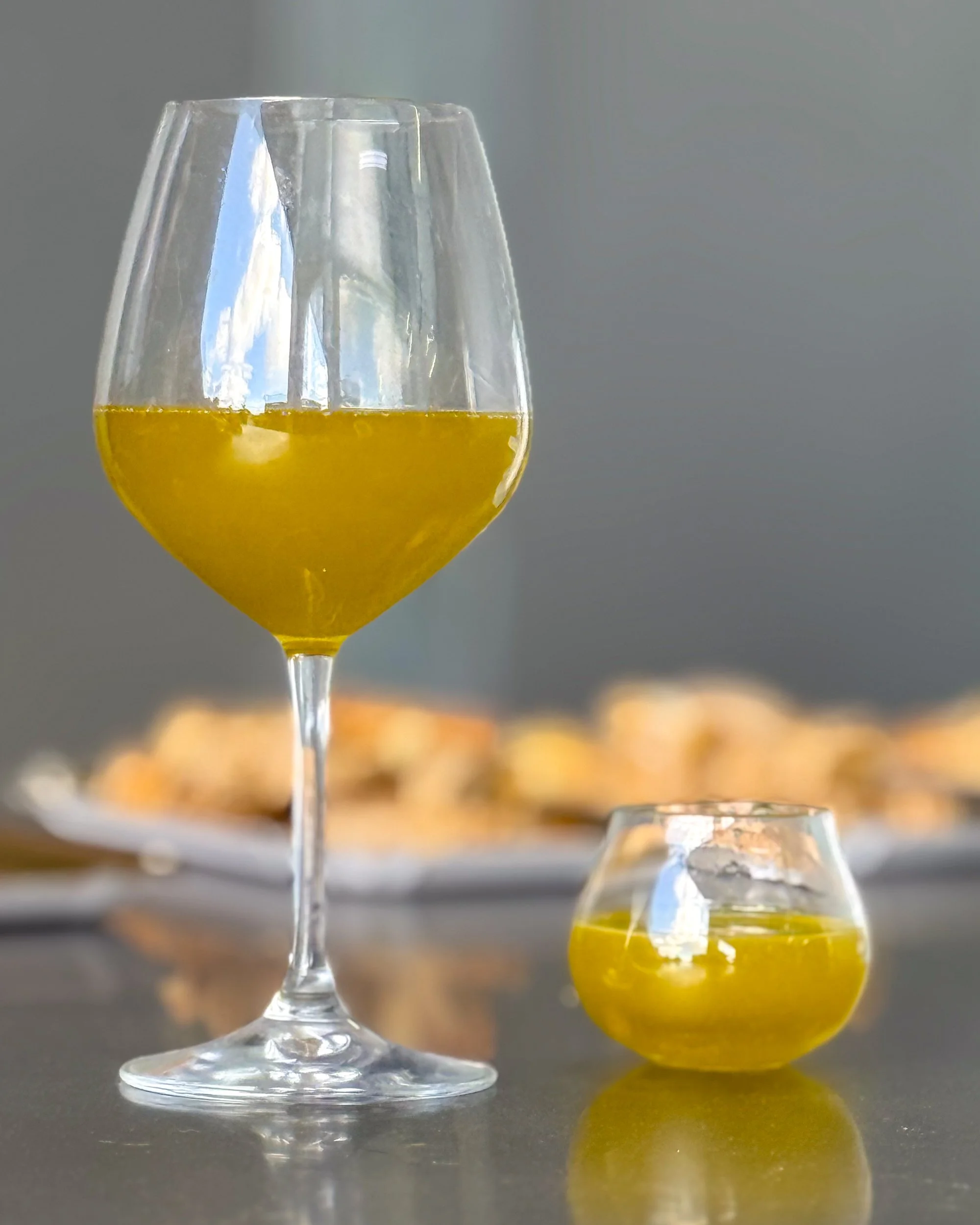
Freshly pressed olive oil photo credit Michele Becci
Italian cooks use different oils at different moments. The seasonal rhythm of the mill becomes the rhythm of the kitchen. When olio nuovo arrives, it’s enjoyed simply. A classic ritual is bruschetta: toasted bread rubbed lightly with garlic and finished with a generous pour of the new oil.
As the oil’s early phenolic intensity softens, it moves into broader everyday use. The mid-season oils, vibrant but less sharp, become the workhorses for sautéing vegetables, finishing pasta, dressing salads, and forming the base of sauces.
Once bottled, cooks think less about the harvest window and more about how the oil matures in the bottle. With time, even the most robust early oil mellows into a softer profile suited to gentler cooking and baking. It becomes the oil for slow braises, soups finished with a swirl of oil, sautéed greens, or olive-oil cakes that rely on subtle richness rather than bold pepperiness. Italians see this evolution not as a decline, but an invitation to use the oil differently as it changes.
Storage habits reflect this mindset: bottles are kept cool, dark, and once opened, used promptly, typically within two to three months. Where many U.S. consumers save special oils, Italians open theirs eagerly, knowing that good-quality olive oil is meant to be part of everyday cooking, not something tucked away.
How and When to Use Olio Nuovo
For home cooks, understanding olive oil’s life cycle is as important as choosing a high-quality bottle. Freshness is the most reliable indicator of quality, more meaningful than labels or marketing terms. Olio nuovo's bold, peppery character reflects abundant polyphenols, which naturally decline once oxygen and light begin interacting with the oil.
It is all part of the oil’s natural evolution. A vibrant, pungent oil will mellow within a few months, settling into the kind of everyday oil cooks reach for most often. Instead of saving a premium bottle of olio nuovo, use it early and often. Cooks enjoy the bright intensity in the first months, then let its softened mid-season profile shine in roasted vegetables, grains, beans, and salads.
A few simple habits will preserve the quality. Bottles should be stored in a cool, dark place, kept sealed, and opened only when they can be finished within two to three months. Bringing a harvest mindset into the home kitchen allows you to enjoy olive oil the way producers do: as a living ingredient that evolves and reveals new flavors over time.
A Toast to the Harvest in Sicily
The evening after the harvest, the Giaramida family hosts a small celebration at their country house. As a local band plays Sicilian folk songs, the family sets out a buffet of meats, cheeses, grilled vegetables, and sweets in the old barn. We fill glasses with local wine and mingle with the family, members of the press who have returned for more interviews, and friends who have come to mark the first day of the harvest.
Then the family hands each guest a small glass. Vito steps forward, pouring a thin line of olio nuovo into each one. We lift our cups as Vito raises his:
“A l’ogghiu novu: ca sia bonu e abbunnanti!” To the new oil - may it be good and plentiful.
Together, we toast the new oil and the start of another season.